
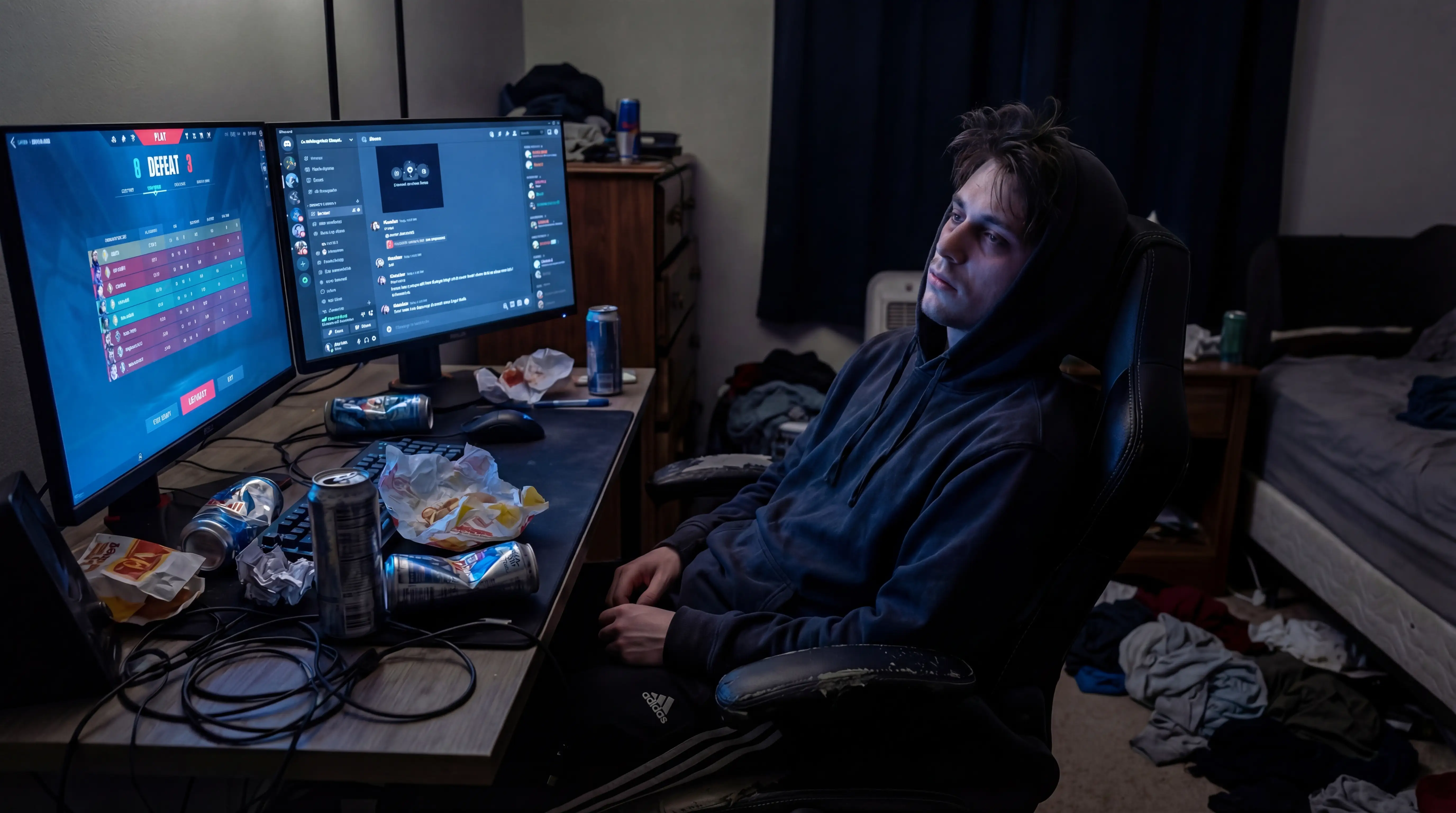
Video Game Addiction Symptoms: 15 Signs It's Time to Hit Reset
Titouan De Dain
Summarize with AI
Need Help Now?
TL;DR: Quick Summary (For the Speedrunners)
- It's not about hours played: It's about loss of control and prioritizing gaming despite negative consequences.
- The Big Red Flags: Preoccupation (thinking about gaming when not playing), withdrawal irritability, and using gaming to escape reality.
- The Diagnosis: If symptoms persist for 12 months or cause major life impairment, the World Health Organization classifies it as "Gaming Disorder."
- The Fix: You can't "moderate" an addiction. A structured detox (30–90 days) is the fastest way to reset your dopamine baseline.
You Sat Down for "One Match." It's Now 4:00 AM.
If you’re reading this, you probably already feel the glitch.
You used to control your gaming. Now it feels like the game controls you.
You tell yourself you'll log off after one last game. Then three hours disappear like you got hit with a flashbang.
This isn't laziness. This isn't weakness.
This is what happens when your brain gets "tuned" to constant, high-intensity reward. Let's break down what's actually happening, and how to fix it.
Is "Gaming Disorder" Real? (The Science)
Gamers have joked for two decades that parents just "didn't understand." But now, the science is uncomfortably clear.
According to the World Health Organization (WHO), "Gaming Disorder" is an officially recognized medical condition.
It's defined by impaired control—when gaming takes precedence over other life interests despite causing damage.
The American Psychiatric Association (APA) lists "Internet Gaming Disorder" in the DSM-5. This condition alters your brain's reward system similarly to substance use disorder, creating:
- Rapidly escalating dopamine spikes
- Compulsive behavior loops
- Physical withdrawal symptoms
Translation: Your brain hasn't failed. It simply learned to crave the most efficient dopamine source available.

15 Video Game Addiction Symptoms (The Checklist)
We've categorized these into four buckets. Research shows that gaming disorder affects 1.96-3.05% of the general population, with higher rates among adolescents and young adults.
If you recognize yourself in 3-4 of these, you're in the risk zone. If you recognize 5+, you need to take action.
1. Mental & Emotional Symptoms ("The Brain Fog")
- Preoccupation: You aren't playing, but you're thinking about your next match, rank, or build. Real life feels like a loading screen.
- Withdrawal Irritability: You feel restless, anxious, or angry when you can't play (e.g., snapping at someone who interrupted a match).
- The "Numb" Effect: You don't game for fun anymore. You game to escape anxiety, guilt, or depression.
- Tolerance: You used to feel satisfied after one hour. Now you need four hours to get the same "hit."
2. Behavioral Symptoms ("The Loop")
- Loss of Control: You promise yourself "10 PM cutoff," but consistently play until 2 AM. You can't stop yourself.
- Deception: You lie about how much you play. You minimize the window when someone walks in.
- Abandoning Other Hobbies: The gym, guitar, or reading feel "boring" compared to gaming's high stimulation.
- Relapse: You've tried to quit before, but always end up back at square one within days.
3. Physical Symptoms ("Hardware Damage")
- Sleep Deprivation: You are chronically tired. You sacrifice sleep for League Points.
- Hygiene Neglect: Showering or brushing your teeth feels like a waste of time.
- Physical Strain: Carpal tunnel, "gamer neck," back pain, or dry eyes (Computer Vision Syndrome).
- Dietary Neglect: You survive on energy drinks and easy carbs because cooking takes time away from the screen.
4. Social & Professional Symptoms ("Solo Queue")
- Jeopardized Relationships: You've lost a partner or drifted from friends because you prioritized gaming.
- Academic/Career Decline: Grades are dropping, or you're missing deadlines. You might call in sick to game.
- Isolation: You feel safer online than offline. Real-world interactions feel like "too much effort."
Why You Can't Just "Play Less"
If you identified with the list above, your first instinct is probably: "Okay, I'll just cut back. I'll only play on weekends."
This rarely works.
Why? Because of neuroplasticity. Gaming addiction rewires your brain's reward system, creating structural changes similar to substance use disorders. Your brain has physically adapted to gaming's high-dopamine environment.
When you try to "moderate," your brain screams for that stimulation. Real life feels slow and gray by comparison.
You don't need moderation. You need a full system reboot.
The Solution: The 90-Day Reset
The most effective way to reverse these symptoms is a period of total abstinence. Research shows that short-term gaming abstinence can significantly reduce Internet Gaming Disorder symptoms, with measurable improvements in self-control and wellbeing.
- Go Cold Turkey: Uninstall the games. Delete the apps. Pack up the GPU or give the console to a friend.
- Expect the "Crash": The first 2 weeks will be difficult. You'll feel bored, anxious, maybe depressed. This is normal, your brain is healing.
- Find High-Effort Replacements: Replace gaming's "cheap dopamine" with "slow dopamine." Lift weights, learn a language, cook. Engage your brain differently.
You Don't Have to Solo Queue This
Realizing you have a problem is the hardest part. But you don't have to fix it alone.
Lume was built by people who've been exactly where you are. We help you track your streak, journal your triggers, and rebuild with support.

Ready to reset your dopamine baseline?
👉 to start tracking your recovery journey and build healthier habits.
👉 Read: How to Quit Gaming Cold Turkey for a complete 90-day detox guide.
Frequently Asked Questions
How do I know if I have gaming disorder?
If gaming causes you to lose control over your time, neglect health or relationships, and you feel irritable when you can't play, you likely have gaming disorder.
How long does gaming withdrawal last?
Acute withdrawal usually lasts 10-14 days, with symptoms including irritability, restlessness, low mood, and strong gaming urges. Mood and motivation typically stabilize after 3-4 weeks.
Is gaming disorder the same as screen addiction?
Not exactly. Gaming disorder involves interactive reward loops (variable reinforcement), which makes it more potent than passive screen use like watching Netflix.
Can you recover from gaming disorder?
Yes. With a structured detox (we recommend 90 days) and habit replacement, your brain's neuroplasticity allows it to heal and reset its dopamine baseline.