
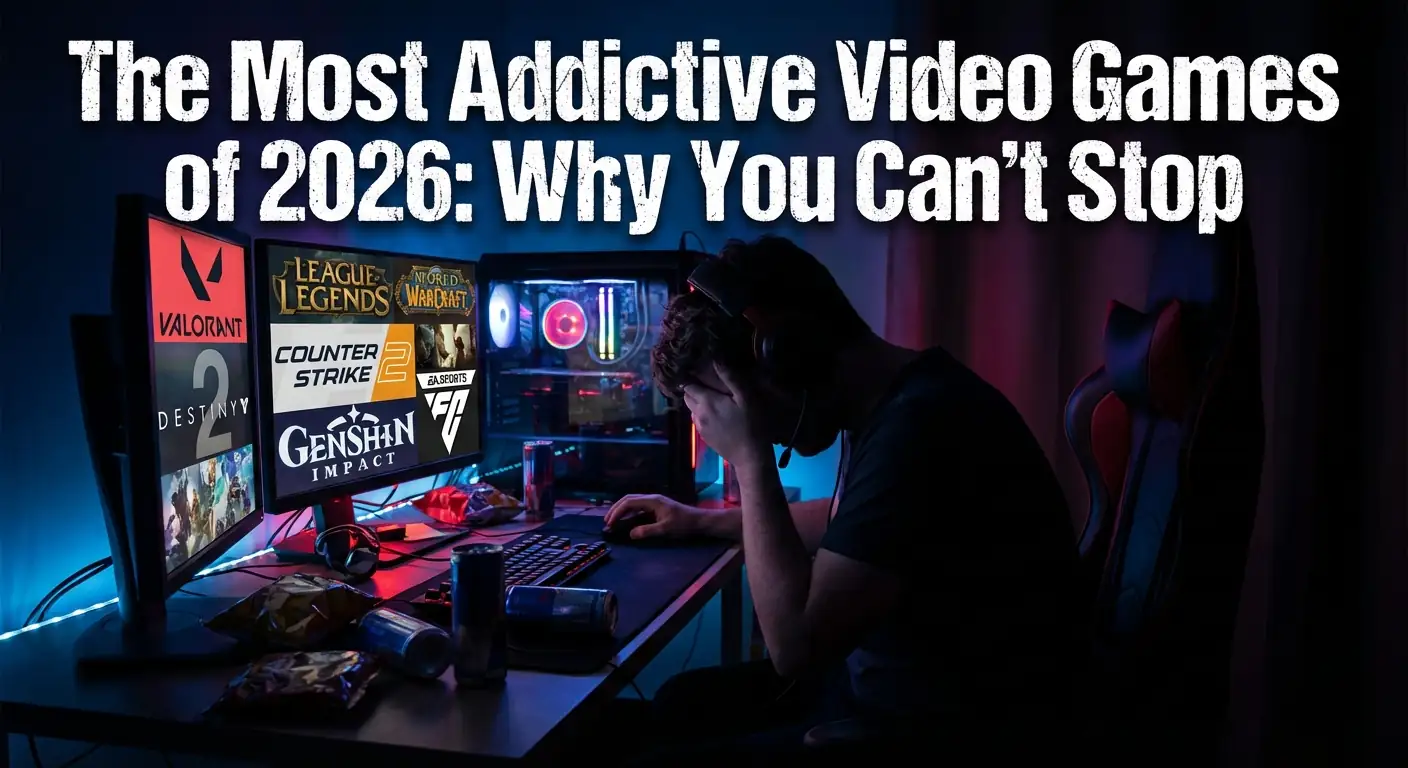
The Most Addictive Video Games of 2026: Why You Can't Stop
Jean Willame
Summarize with AI
This article discusses gaming addiction and recovery strategies. If you're experiencing a mental health crisis, please contact a mental health professional immediately. This content is educational and not a substitute for professional medical advice.
If you feel like you can't log off in 2026, it's not because you're weak or "lazy." It's because the algorithm is stronger than you.
Game design has evolved. Developers aren't just making games "fun" anymore; they are using behavioral psychology to create addictive video games that hijack your dopamine system. They use well‑studied reward and learning mechanisms to strongly engage your brain's reward circuits, knowing exactly when to give you a win, when to force a loss, and how to trigger the fear of missing out (FOMO) so deep you feel physical anxiety when you're out of the game.
You aren't just playing against other people. You're playing against a billion-dollar retention algorithm. It's a David against Goliath!
Here is the watchlist of the most addictive video games in 2026, and the science of why they own your brain.
My name is Jean and I've been truly addicted to video games from 13 to 20. I'm now completely free from gaming and I want to help others quit this terrible addiction that almost ruined my life.
Most Addictive Video Games in 2026: Pick Your Poison
We don't list these to shame you. We list them so you can identify the Addiction Archetype you're trapped in.
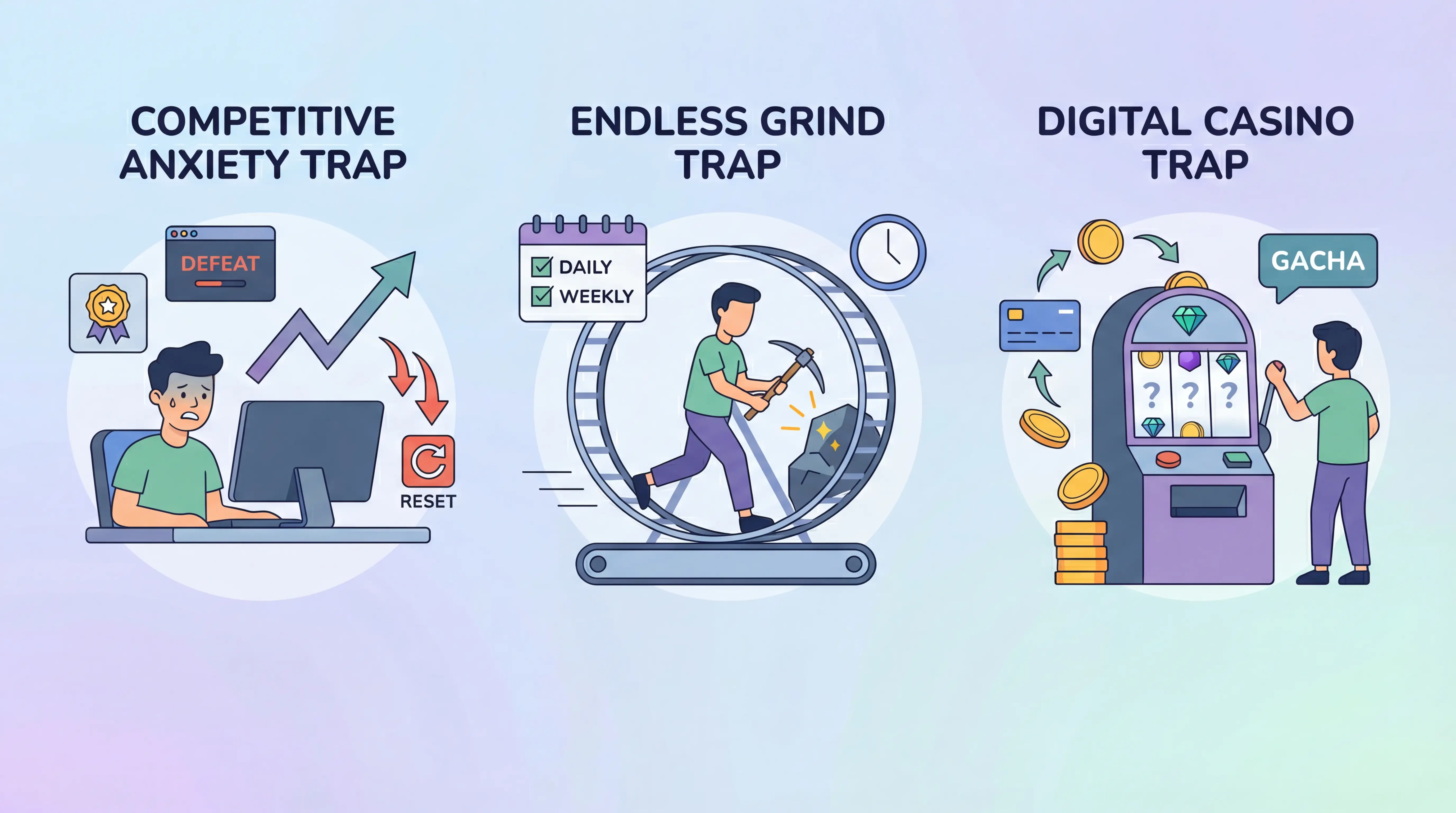
1. The "Competitive Anxiety" Trap
- The Games: Valorant, League of Legends, Counter-Strike 2…
- The Hook: The "Elo Hell" loop.
These games thrive on intermittent reinforcement. You don't play for fun, you play to fix the mistake of the last match. When you lose, you queue up again to prove you aren't bad. When you win, you don't feel joy, you feel relief. This cycle keeps your cortisol (stress) high and your dopamine spiking unpredictably, creating a chemical dependency identical to gambling. - The Lume Take: You aren't "grinding to Radiant." You are laboring for a rank that resets every few months to keep you on the treadmill.
2. The "Endless Grind" Trap
- The Games: World of Warcraft: Midnight, Destiny 2, Path of Exile 2
- The Hook: The Sunk Cost Fallacy.
These MMOs are designed to make quitting feel like throwing away an investment. You've spent 4,000 hours building your character; walking away feels like burning money. They weaponize "Daily Resets" and "Weekly Lockouts" to turn gaming into a chore list. If you miss a day, you fall behind. - The Lume Take: This isn't a hobby. It's an unpaid second job where the currency (gear mostly) inflates to zero every time a new patch drops.
3. The "Digital Casino" Trap
- The Games: Genshin Impact, Honkai: Star Rail, EA Sports FC 26 (FIFA)
- The Hook: Variable Ratio Reinforcement.
This is the most potent addiction mechanic known to science. Whether it's opening a player pack or pulling for a 5-star character, you are pulling a slot machine lever. The "pity system" (guaranteed wins after X losses) exists only to keep you from quitting before the addiction sets in. - The Lume Take: The game is free until the dark pattern in it makes you use the credit card to not fall behind the others.
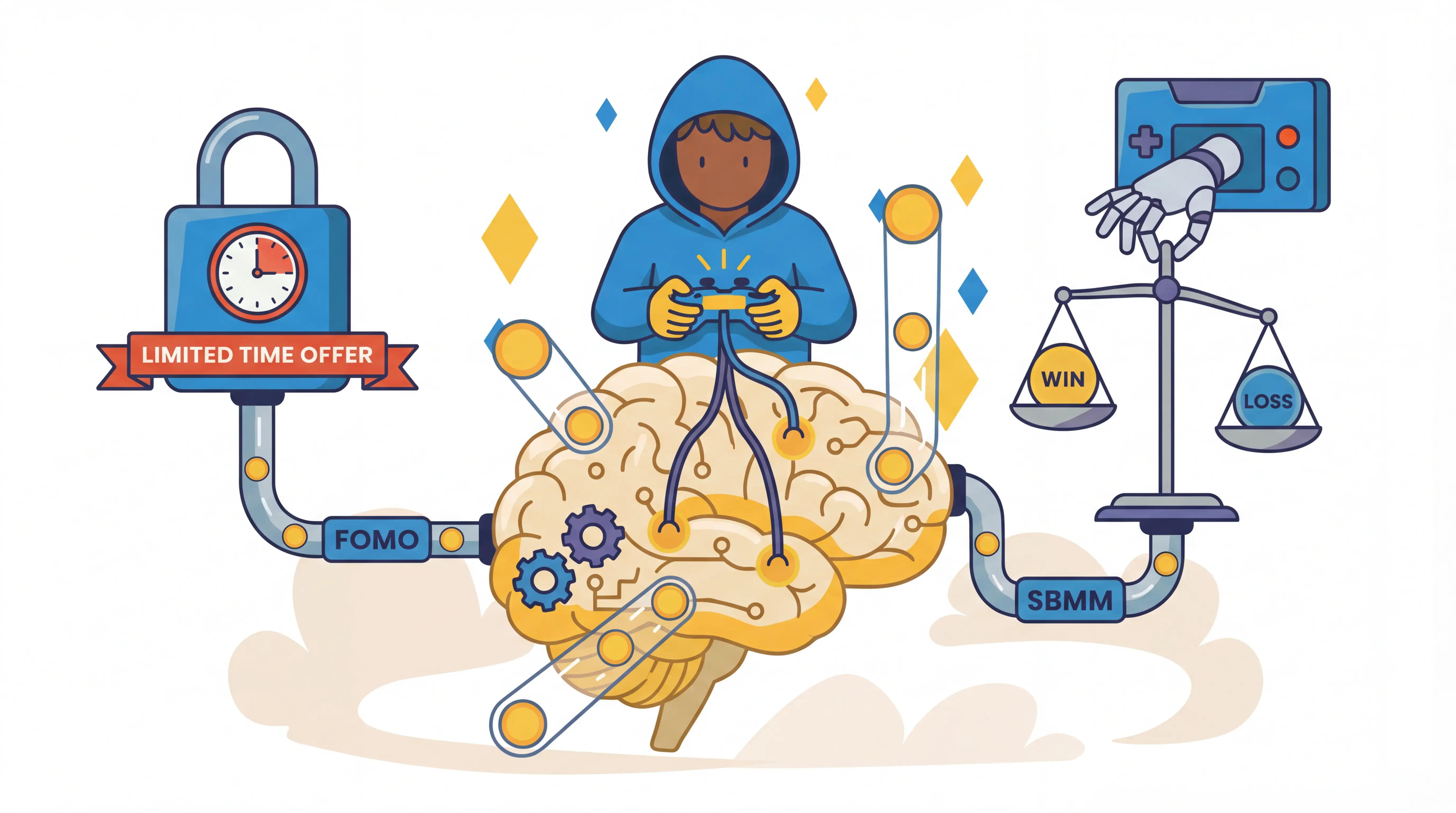
How Addictive Video Games Hack Your Brain
It doesn't matter if you shoot terrorists or slay dragons. The underlying code running on your brain is the same. Here are the exploits every major studio is using in 2026:
1. Weaponized FOMO (Battle Passes)
Battle Passes utilize Loss Aversion. Psychologically, the pain of losing something is twice as powerful as the pleasure of gaining it. By putting a timer on rewards, developers force you to log in not because you want to play, but because you fear losing the skin you already "paid" for.
- Translation: You are clocking in to avoid a penalty.
2. Algorithmic Matchmaking (SBMM)
Skill-Based Matchmaking (SBMM) isn't just about fairness; it's about retention. If you win too much, you get bored. If you lose too much, you quit. The algorithm is designed to keep you in the "Goldilocks Zone" of frustration: winning just often enough to keep hope alive, but losing enough to keep you hungry.
- Translation: The game is rigging your dopamine drip.
Gaming Addiction Test: Am I Addicted?
Forget the "how many hours" question. High-functioning addicts can play 2 hours a day; engaged pros can play 10. The difference is control.
Ask yourself these three questions (be brutally honest):
- The "AFK" Anxiety: Do you feel restless, irritable, or "empty" when you aren't playing? (This is withdrawal).
- The Priority Shift: Have you skipped the gym, a shower, or a meal to finish a "daily" task?
- The Logic Override: Do you know you should stop at 11 PM, but physically can't stop until 3 AM?
If you answered YES, your prefrontal cortex (the logic center) has been overridden by your limbic system (the impulse center).
And these 3 questions aren't enough to identify concretely if you are addicted or at risk. You might need to do our comprehensive test in the Lume application which is way more precise with questions validated by WHO's tests pattern. Learn more about gaming addiction signs and symptoms here.
You can test yourself right now by downloading Lume (completely free):
How to Quit Gaming: 3 Science-Backed Steps
You can't just "use willpower." You are fighting a supercomputer designed to beat your willpower. You need a strategy.
Step 1: The Hard Reset (Cold Turkey)
Moderation is a myth for addicts. You need to reset your dopamine baseline.
- Action: Uninstall the games. Unfollow the streamers. Delete the discord apps. You need 3-4 weeks of zero contact to let your brain's hardware heal. Move away from anything that could trigger you, even this friend that only talk about gaming (I've had to do that too..)
Most studies show that changing problematic gaming patterns requires at least several weeks of structured abstinence, and even a few days of complete abstinence can already reduce cravings and distorted thoughts. For many people with a genuine addiction pattern, taking a few weeks completely off games is much more effective than 'trying to moderate'. Learn more about the cold turkey method and dopamine reset here.
Step 2: Find a Co-Op Partner (Accountability)
Isolation feeds addiction. Your brain will lie to you ("Just one game is fine").
- Action: Tell a friend or partner you are quitting. Give them permission to call you out. You need an external server to host your logic while yours is rebooting.
I did it with Titouan, my partner on Lume project, we knew something had to change so we count on each other to quit gaming and stay accountable.
Step 3: Fix the "Content Drought" (Fill the Void)
If you delete the game but sit in your gaming chair staring at the wall, you will relapse. You removed a high-dopamine activity, you must replace it with something.
- Action: Lift heavy weights (endorphins). Learn a complex skill (coding, guitar). Give your brain a new grind that actually rewards you with real-life XP. Check out our complete guide on what to do instead of gaming.

The Final Boss is You
The game devs aren't coming to save you. They are counting on you to stay hooked.
Pressing Alt+F4 on your addiction is the hardest raid mechanic you will ever learn. But unlike addictive video games, the loot you get here—your time, your focus, your life—you actually get to keep.
Ready to start your new save file? Check out Lume's complete guide to resetting your dopamine baseline, or download the app to start your recovery journey today:
Sources:
- Reward mechanisms in video games and dopamine pathways — Neuroscience & Biobehavioral Reviews
- Problematic gaming and its similarities to gambling disorder — PMC, National Library of Medicine
- Dark patterns and engagement loops in online games — arXiv
- Variable ratio reinforcement schedules in game design — University of Plymouth
- Internet Gaming Disorder diagnostic criteria — American Psychiatric Association
- Cognitive Behavioral Therapy for gaming addiction — PMC, National Library of Medicine
- CBT treatment outcomes for internet gaming disorder — PMC, National Library of Medicine
- Loss aversion and behavioral economics — The Decision Lab
- AI and behavioral manipulation in modern game design — arXiv